Table of Contents
Key Takeaways
- A fully functional home gym can be assembled for under $100 with resistance bands, a yoga mat, adjustable dumbbells, and a jump rope
- Bodyweight exercises like push-ups, squats, lunges, and planks build real strength without any equipment when you focus on progressive overload
- Resistance bands provide variable resistance that builds muscle effectively while taking up minimal space and costing under $25
- A 6x6 foot area is sufficient for most home workouts, making even small apartments suitable for a dedicated exercise space
- Consistency and progressive overload matter more than equipment quality for achieving fitness results at home
Planning Your Home Gym Space
Before buying any equipment, evaluate the space you have available and how it will function as a workout area. The good news is that a serviceable home gym requires surprisingly little room. A 6x6 foot area is sufficient for floor exercises, yoga, and bodyweight workouts. A 6x8 foot area accommodates resistance band work and light dumbbell training. If you plan to add a bench or larger equipment later, a 10x10 foot space provides comfortable room for most exercises. Measure your longest potential position, typically lying flat on the ground with arms extended overhead, to confirm adequate clearance in all directions.
Choose a location with good ventilation and sufficient lighting. Basements, spare bedrooms, garage corners, and even living room corners can work well. Consider flooring carefully: carpet works for most exercises but makes cleanup harder, while rubber mats or interlocking foam tiles protect both your floor and your equipment. A simple 4x6 foot set of interlocking foam tiles costs roughly $20 and provides a comfortable, non-slip surface that defines your workout zone. Good airflow and access to water are important considerations that are often overlooked until you are halfway through a workout.
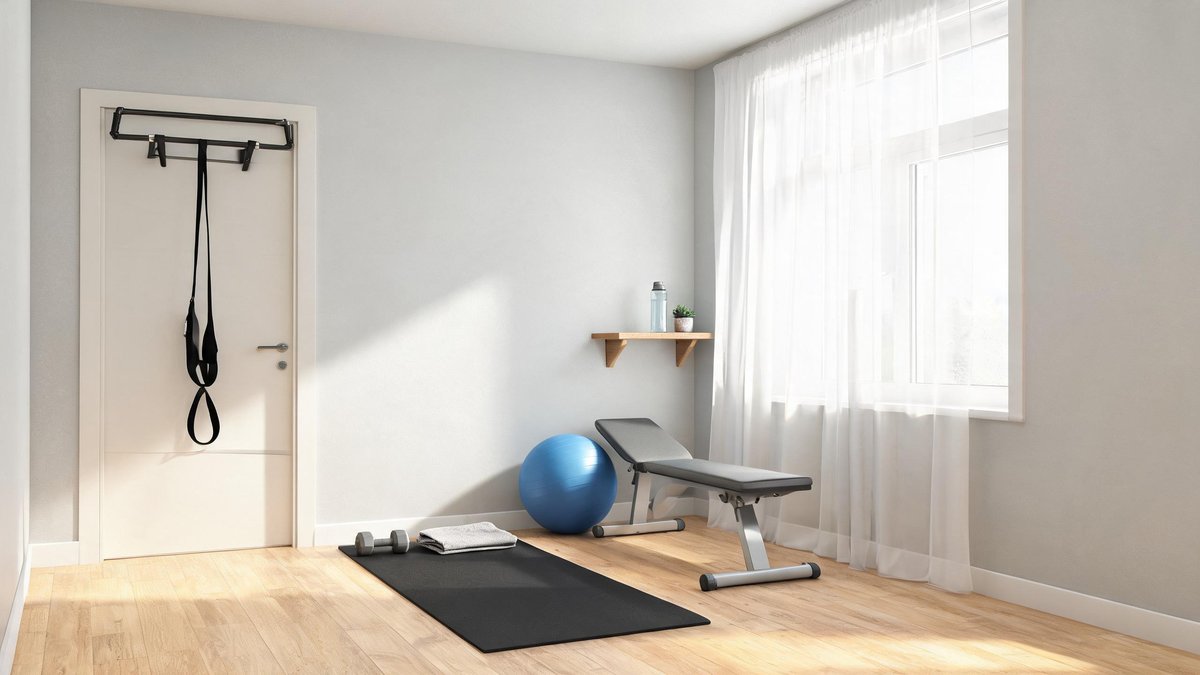
Storage is another important planning consideration. Resistance bands hang on a hook, dumbbells sit in a corner, and a yoga mat rolls up and leans against the wall. A small shelving unit or storage bin keeps your equipment organized and accessible. The key is designing a setup that requires minimal setup time: if you have to move furniture or dig through a closet to access your equipment, you will find excuses to skip workouts. Make your gym as easy to use as possible by keeping equipment visible and ready to go at all times.
Essential Equipment Under $100
Building a home gym on a tight budget is entirely achievable with strategic equipment choices. The most cost-effective purchases start with resistance bands, which provide variable resistance for a full-body workout and pack away into a small pouch. A set of fabric or latex resistance bands with multiple resistance levels (light, medium, heavy) costs $15 to $25 and replaces dozens of weight machines. Loop bands work well for lower body exercises, while tube bands with handles are better for upper body movements. Resistance bands are also portable, making them perfect for travel workouts.
A quality yoga mat is your second essential purchase at $15 to $20. Look for a mat at least one quarter inch thick for comfortable floor exercises, stretching, and core work. Thicker mats (half inch) provide more cushioning for sensitive joints but are heavier to transport and store. A mat with a non-slip surface prevents slipping during sweaty workouts and protects your floor from dropped equipment. The same mat works for yoga, Pilates, stretching, core exercises, and as a kneeling pad for floor exercises.
Adjustable dumbbells cost $40 to $60 for a basic pair and replace an entire rack of individual weights. Look for a set that ranges from 5 to 25 pounds per dumbbell with easy adjustment mechanisms. Cast iron adjustable dumbbells with a threaded collar system are durable and affordable. If your budget is extremely tight, skip the dumbbells initially and rely on resistance bands and bodyweight exercises. Add a jump rope ($5 to $10) for cardio conditioning. A quality jump rope with ball bearings in the handles provides smooth rotation and adjustable length. For roughly $100 total, you have a complete home gym that targets every muscle group and cardiovascular system.
Bodyweight Exercises That Build Real Strength
Bodyweight training is not just for beginners. When performed with proper technique and progressive overload principles, bodyweight exercises build functional strength, muscular endurance, and even muscle hypertrophy. The fundamental bodyweight exercises that form the foundation of any home workout program include push-ups, squats, lunges, planks, glute bridges, and rows using a sturdy table or doorway anchor. Master these six movements with perfect form before progressing to more challenging variations.
Progressive overload with bodyweight exercises requires creativity. You can increase the difficulty of push-ups by progressing from knee push-ups to standard push-ups to decline push-ups (feet elevated) to archer push-ups and finally to one-arm push-ups. Squats progress from bodyweight squats to goblet squats (holding a dumbbell or heavy object) to Bulgarian split squats to pistol squats (single-leg squats). Each progression increases the load on your muscles without requiring any additional equipment. Slow down your repetitions, aiming for 3 to 4 seconds per rep, to increase time under tension and maximize muscle recruitment.
Pull-ups are the one bodyweight exercise that requires dedicated equipment. A doorway pull-up bar costs $20 to $30 and installs without tools in most door frames. If your door frames cannot accommodate a pull-up bar, use resistance bands anchored to a sturdy door frame for rowing and pulling exercises. Push-ups, dips (using a sturdy chair), and pike push-ups (for shoulder development) cover your pushing muscles. Squats, lunges, and glute bridges cover your lower body. Planks, dead bugs, and hollow holds build core strength. This combination creates a complete bodyweight routine that works every major muscle group.
Creating an Effective Workout Routine
A well-designed home workout routine balances frequency, intensity, and recovery. For most people, three full-body workouts per week on non-consecutive days provides optimal results. Each session should include one push exercise (push-ups or dips), one pull exercise (rows or pull-ups), one squat variation (bodyweight squats or lunges), one hinge exercise (glute bridges or single-leg deadlifts), and one core exercise (planks or dead bugs). Perform 3 sets of 8 to 15 repetitions per exercise with 60 to 90 seconds rest between sets.
Structure your weekly schedule to maintain consistency. Monday, Wednesday, and Friday workouts work well for most schedules. Each session should take 30 to 45 minutes including warm-up and cool-down. Begin each workout with 5 minutes of dynamic stretching: arm circles, leg swings, torso twists, and light jogging in place. After your workout, spend 5 minutes stretching the muscles you worked, holding each stretch for 20 to 30 seconds. This warm-up and cool-down routine reduces injury risk and improves recovery.
To continue making progress, increase the challenge every 2 to 4 weeks. You can add more repetitions, increase the number of sets, reduce rest time between sets, progress to harder exercise variations, or add external resistance with bands or dumbbells. Track your workouts in a simple notebook or app to ensure you are consistently progressing. If you can complete all sets and reps with good form, it is time to increase the challenge. This principle of progressive overload is the foundation of all strength gains, regardless of equipment availability.
Progressive Overload Without Heavy Weights
Progressive overload does not require a gym full of heavy barbells and weight plates. Several effective methods increase exercise difficulty using only bodyweight, bands, and light dumbbells. Volume progression means gradually increasing your total number of repetitions over time. If you completed 50 push-ups total across all sets this week, aim for 55 next week. This simple approach works for months before you plateau, especially when combined with other progression methods.
Tempo manipulation is a highly effective but often overlooked progression method. Slowing down your repetitions dramatically increases time under tension, which is a primary driver of muscle growth. Try performing each rep with a 3-second lowering phase, a 1-second pause at the bottom, and a 1-second lifting phase. You will find that exercises become significantly harder even though the weight or resistance has not changed. Eccentric emphasis, where you lower the weight even more slowly (4 to 5 seconds), creates muscle damage that stimulates growth and strength adaptations.
Rest reduction is another powerful progression tool. Reducing rest periods between sets from 90 seconds to 60 seconds to 30 seconds increases workout density and cardiovascular demand. Advanced techniques like drop sets, supersets, and circuit training maximize results in minimal time. With resistance bands, you can also use band combinations to increase resistance: loop two bands together or add a heavier band for exercises that feel too easy. The key is always finding a way to make the exercise slightly harder than last time, whether through more reps, slower tempos, shorter rest, or harder variations.
Staying Motivated and Consistent
Motivation is what gets you started, but consistency is what gets you results. The most common reason home gyms fail is not lack of equipment but lack of structure. Treat your home workouts with the same importance as any other appointment: schedule them on your calendar, prepare your workout clothes in advance, and protect that time from other obligations. Having a dedicated workout space that is always set up and ready removes the biggest barrier to consistency.
Accountability significantly improves adherence to home workout programs. Share your fitness goals with a friend or family member and check in with them after each workout. Join online fitness communities focused on home training for support, ideas, and motivation. Consider scheduling video call workouts with a friend who also exercises at home. Knowing someone is expecting you to show up makes it much harder to skip a session. Tracking your progress in a visible way, such as marking completed workouts on a wall calendar, provides visual reinforcement of your consistency.
Finally, keep your workouts varied and enjoyable. Follow a structured program for 4 to 6 weeks, then switch to a different program or try new exercises. Explore free workout videos on YouTube for guided sessions, particularly in areas like yoga, bodyweight strength, and high-intensity interval training. Celebrate small victories: completing your first unassisted push-up, holding a plank for 60 seconds, or fitting into clothes that were tight before. These tangible results remind you why you started and keep you moving forward. According to the Wikipedia article on physical fitness, regular exercise improves not only physical health but also mental well-being, cognitive function, and sleep quality.